
Hutto, Texas, is currently one of the fastest-growing suburbs in the Greater Austin area. Known for its “Hippo Nation” pride and family-friendly atmosphere, the city is seeing entire neighborhoods spring up overnight. If you’ve recently moved into a brand-new home in Hutto, you likely expect everything to be pristine, sealed, and protected from the elements.
However, there is a hidden flaw in modern construction that most homeowners—and even many home inspectors—overlook. It’s called the “Builder’s Gap.” At Prickly Pear Wildlife Removal, we are seeing a massive surge in calls from new Hutto developments where birds, bats, and rodents have already moved into attics before the moving trucks have even left. In this guide, we’ll explain what a Builder’s Gap is, why Hutto’s rapid growth exacerbates the problem, and how our “New Home Hardening” process can save you thousands in future repairs.
What is a “Builder’s Gap”?
In the rush to complete hundreds of homes on tight deadlines, construction crews often focus on speed and aesthetic finishes. One area that frequently gets “shortcut” is the junction where the roof decking meets the fascia board (the trim behind your gutters).
In a perfect world, these two surfaces would meet flush, or the drip edge would be installed so tightly that nothing could pass through. In reality, a “Builder’s Gap” of half an inch to two inches is often left behind. While this might seem insignificant, it is essentially a “Welcome” sign for Texas wildlife.
Why Hutto is the “Epicenter” of the Gap Problem
Because Hutto is largely built on former agricultural land and open prairies, the local wildlife is suddenly finding their nesting trees replaced by rooftops. Birds like starlings and house sparrows are highly opportunistic; they see that small gap as a safe, elevated entrance to a massive, climate-controlled nesting site: your attic.
The Bird Problem: More Than Just a Nuisance
While seeing a bird fly into your eaves might seem harmless, the reality of a nesting colony in your attic is a serious maintenance and health issue.
1. The “Nesting Disaster”
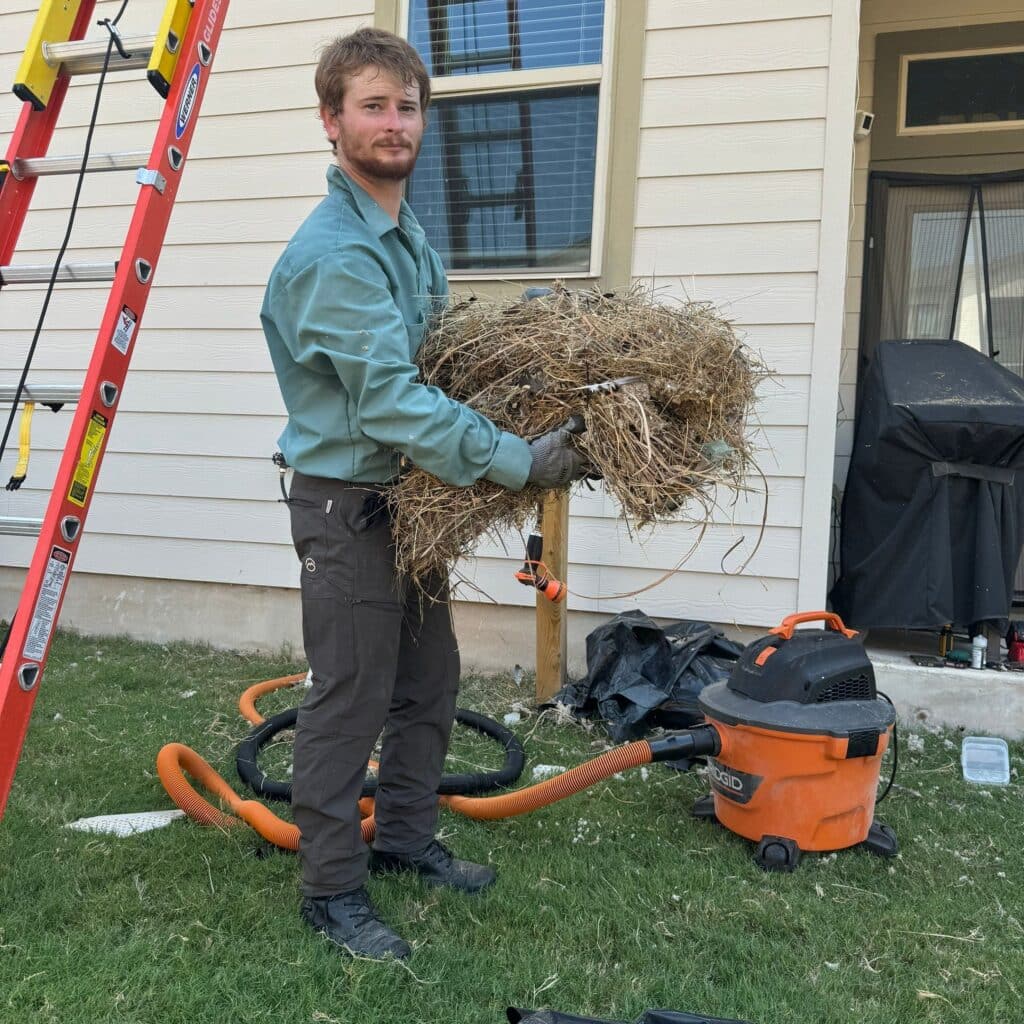
Birds don’t just bring themselves; they bring “bedding.” We have seen Hutto attics filled with several feet of dry grass, twigs, and trash. This material is highly flammable and often rests directly on top of recessed lighting or electrical wiring, creating a significant fire hazard.
2. Acidic Damage
Bird droppings (guano) are highly acidic. Over time, they can eat through the paint on your fascia boards, corrode metal venting, and ruin your attic insulation.
3. Bird Mites
When birds nest in your attic, they often bring bird mites—tiny parasites that live on the birds. Once the birds leave the nest or the population gets too high, these mites often find their way through ceiling fixtures or AC vents into your living space, looking for a new host.
The “New Home Hardening” Solution
At Prickly Pear, we believe it is much cheaper to keep a bird out than to clean up after one has moved in. Our New Home Hardening service is designed specifically for the unique construction styles found in Hutto’s newest subdivisions.
Step 1: The High-Reach Inspection
We don’t just look from the ground. We use high-reach ladders and specialized cameras to inspect every inch of your roofline. We specifically look for “shadow gaps” where the roof meets the eaves—these are the primary entry points for starlings and sparrows.
Step 2: Professional Exclusion Materials
Many DIYers try to “stuff” these gaps with expanding foam. This is a mistake. Birds can peck through foam in minutes, and it degrades quickly in the Texas sun.
We use professional-grade wildlife fencing and galvanized steel flashing. We custom-bend these materials to fit the specific angles of your roofline, ensuring a seal that is both bird-proof and aesthetically pleasing. We match the color of our materials to your trim so the protection is invisible from the street.
Step 3: Vent and Soffit Reinforcement
Builder-grade vents are often made of thin plastic that can be easily bypassed. As part of our hardening process, we install heavy-duty steel covers over your attic fans, gable vents, and dryer exhausts. This ensures that even the most determined Hutto wildlife can’t find a “back door” into your home.
Why “Wait and See” is a Costly Strategy
If you notice a bird flying into your roofline, the clock is already ticking. A single pair of starlings can have multiple “broods” in a single season. What starts as a small gap today can become a massive sanitation project by next year.
The Cleanup Cost vs. The Prevention Cost: The cost to “harden” a new home is a fraction of the cost required to perform a full attic restoration. Once insulation is contaminated with bird droppings and nesting material, it often has to be completely removed, the space must be professionally decontaminated, and new insulation must be blown in.
Conclusion: Hippo Nation’s First Line of Defense
You worked hard for your new home in Hutto. Don’t let a small construction oversight lead to a major wildlife problem. Whether you are in Sienna, Star Ranch, or Cottonwood Creek, your home is likely at risk for the “Builder’s Gap.”
Prickly Pear Wildlife Removal is your local expert in “New Home Hardening.” We live and work in the Pflugerville/Hutto area, and we know exactly where Hutto builders tend to leave those gaps. We aren’t just here to remove wildlife; we’re here to make sure your home stays as new on the inside as it looks on the outside.